Enjoy 5% OFF + FREE shipping on orders $49+! Use Code: 202512AK5

Enjoy 5% OFF + FREE shipping on orders $49+! Use Code: 202512AK5

Some farsighted or presbyopic users may be able to use VITURE Luma, but +SPH, ADD, reading glasses, and insert-order values should not be treated as the same thing. A plus SPH value usually points to farsighted correction, while ADD is a near-vision addition used with multifocal or reading-related prescriptions. Reading glasses are usually built around near tasks, and VITURE Luma insert orders may require a different prescription context. Before ordering custom inserts, confirm whether you need distance, intermediate, or near values, plus SPH, CYL, AXIS, and PD. For the broader buying path, start with the VITURE Luma prescription lenses guide, then use this page to sort out +SPH, ADD, and reader confusion.
Does VITURE Luma Work With Farsightedness or Presbyopia?
VITURE Luma may work for some farsighted or presbyopic users, but the answer depends on what correction the user actually needs. The safest way to think about it is not “Do I have +SPH?” or “Do I use reading glasses?” but “Which prescription values are needed for the viewing distance and insert route I am using?”
VITURE’s own prescription lens frame information is useful context here. On its official prescription lens frame page, VITURE states that its customized prescription lenses are currently Single Vision distance prescriptions only, and that progressive, bifocal, and ADD lenses are not currently supported for that VITURE route. That is VITURE’s official ordering path, not automatically ANNKUTVR’s rulebook. Third-party insert options should be checked according to their own ordering instructions.
The main takeaway is still the same: if your prescription includes +SPH, ADD, readers, progressives, or bifocals, confirm the correct values before ordering. A product page should not diagnose your vision needs or tell you how to convert a prescription.
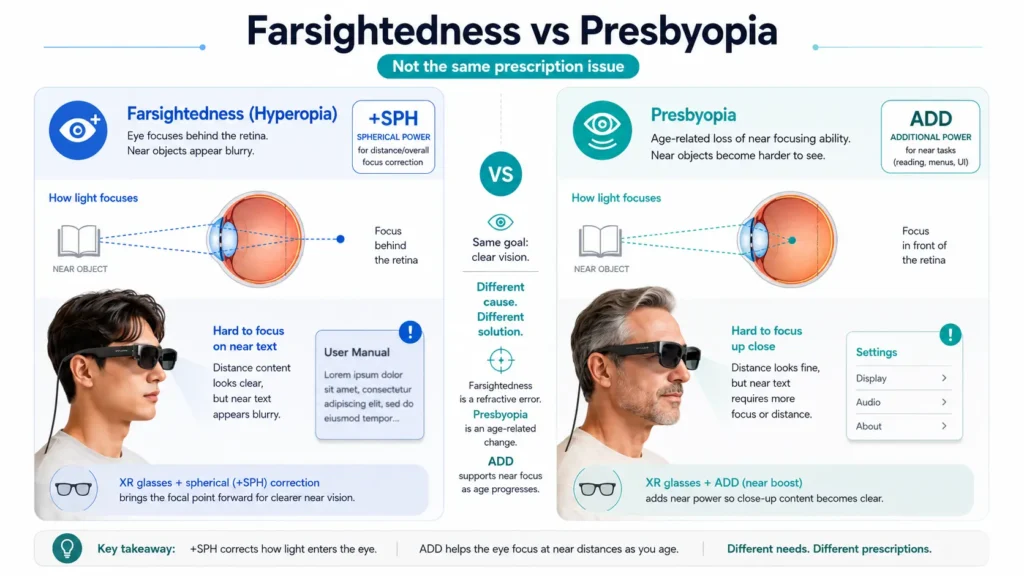
Farsightedness vs Presbyopia: Why They Are Not the Same
Farsightedness, also called hyperopia, and presbyopia can both make close-up tasks harder, but they are not the same issue. Cleveland Clinic explains hyperopia as a focusing disorder that can make close-up objects blurry and may also cause eye strain or headaches. Some people with stronger hyperopia can have blur at more than one distance.
Presbyopia is different. The National Eye Institute describes presbyopia as an age-related near-vision issue that makes it harder to focus up close. Cleveland Clinic also notes that presbyopia and hyperopia can both affect near vision, but the underlying causes are different.
For VITURE Luma users, that distinction matters because the correct value for XR viewing may not be the same as a simple reading-glasses value. A farsighted prescription, a presbyopia ADD value, and an OTC reader strength all point to different kinds of correction decisions.
What Does +SPH Mean on a Prescription?
SPH, or sphere, is the main lens power value on an eyeglass prescription. A plus SPH value is commonly associated with farsighted correction. A minus SPH value is commonly associated with nearsighted correction.
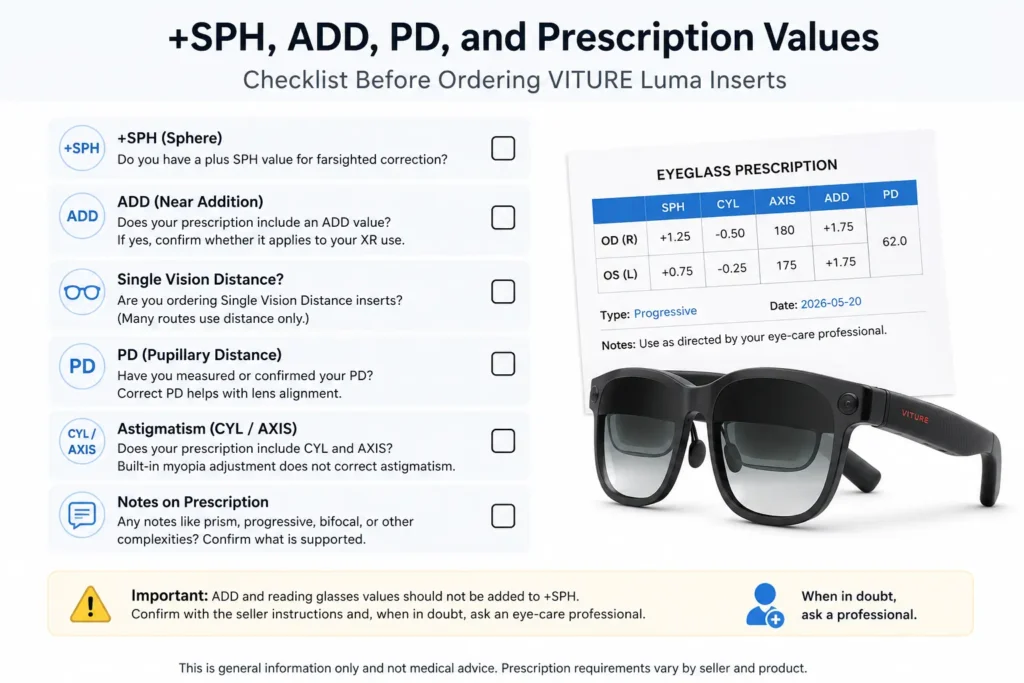
That sounds simple, but it should not become a shortcut for ordering VITURE Luma inserts. A prescription may also include CYL and AXIS for astigmatism, PD for lens alignment, and ADD for near-vision support. If you want a fuller field-by-field refresher, use the VITURE Luma prescription values article before placing any custom order.
For VITURE Luma farsightedness questions, +SPH tells you there may be farsighted correction involved. It does not answer which viewing distance your insert should be made for, whether your prescription includes astigmatism, or whether an ADD value applies.
Is +SPH the Same as ADD?
No. +SPH and ADD are not the same prescription field.
SPH is the sphere power used in the main prescription. ADD is a near addition used in multifocal or reading-related correction. Cleveland Clinic’s prescription explainer describes ADD as an additional power used to create another viewing zone.
This is why users should not treat ADD as a value to automatically combine with SPH for VITURE Luma inserts. If your prescription includes ADD, progressives, bifocals, or readers, ask which values are needed for the specific insert route. If your prescription is multifocal or complex, a separate progressive and bifocal prescription guide is worth reviewing before you order.
| Field or value | What it usually means | Why it matters for VITURE Luma | What to confirm |
|---|---|---|---|
| +SPH | A plus sphere value commonly associated with farsighted correction. | It may show that farsighted correction is part of your prescription, but it does not decide the insert order by itself. | Confirm whether the insert route needs distance, intermediate, or near values. |
| ADD | A near addition used with reading, bifocal, progressive, or multifocal correction. | ADD is not the same as base SPH and should not be handled casually. | Ask how ADD should be handled before ordering any single vision insert. |
| Reading glasses | Correction for near tasks such as reading a book or phone. | Near-reader values may not match the XR viewing distance or custom insert requirements. | Check whether you need a distance, intermediate, or reading prescription for your use case. |
| Single vision distance | One prescription power intended for distance viewing. | VITURE’s official prescription lens frame page says its customized lenses are Single Vision distance only. | Verify whether your chosen seller or insert route uses the same prescription type. |
Are Reading Glasses Values Enough for VITURE Luma Inserts?
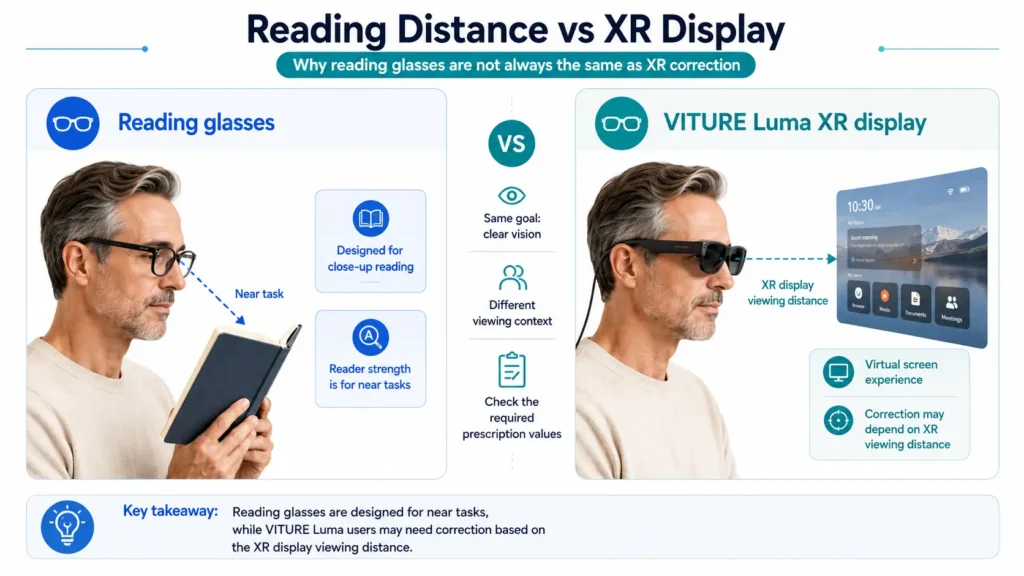
Reading glasses values are not automatically enough for VITURE Luma inserts. Readers are generally designed for close-up tasks. VITURE Luma, meanwhile, is an XR display experience, and the prescription context may not match a simple near-reader strength.
The issue is not that readers are “wrong” for everyone. The issue is that readers do not always contain the full information needed for custom lens ordering. Depending on the user, an insert order may need separate right-eye and left-eye values, CYL and AXIS for astigmatism, PD for alignment, and a confirmed distance or intermediate prescription.
The National Eye Institute explains that single vision and multifocal lenses serve different correction needs. That matters because a reading-only value, an ADD value, and a distance prescription are not interchangeable labels.
Should You Use Distance, Intermediate, or Reading Values?
Confirm the required values before ordering. Do not guess.
For VITURE’s official prescription lens frame route, VITURE says its customized prescription lenses are Single Vision distance prescriptions only. It also says progressive, bifocal, and ADD lenses are not currently supported for that official route, and progressive or bifocal users should enter distance prescription and leave ADD blank when placing that VITURE order.
That official VITURE information is a useful caution signal, but it does not automatically define every third-party insert provider’s ordering rules. If you are comparing ANNKUTVR inserts, check the ANNKUTVR product instructions and make sure your values are current and complete. If your prescription is unclear, ask an eye-care professional or qualified optical provider before buying.
| Your situation | Common confusion | Safer next step |
|---|---|---|
| You have +SPH values | Assuming +SPH alone tells you what to order. | Confirm the full prescription, including CYL, AXIS, PD, and intended viewing distance. |
| You use OTC reading glasses | Assuming reader strength equals insert strength. | Ask whether you need a formal eyeglass prescription for distance or intermediate viewing. |
| Your prescription includes ADD | Treating ADD as the value to enter for inserts. | Confirm how ADD should be handled before ordering single vision inserts. |
| You wear progressives or bifocals | Copying the multifocal prescription directly. | Confirm whether distance values are required, and check the seller’s rules before ordering. |
| Text is still blurry | Assuming the issue must be farsightedness or presbyopia. | Check fit, PD/IPD, astigmatism, lens cleanliness, and prescription values before buying anything. |
Why VITURE Luma May Still Look Blurry With +SPH or Readers
If VITURE Luma still looks blurry while using +SPH correction or reading glasses, the cause may not be presbyopia alone. Blurry text can come from several overlapping factors:
- the wrong viewing-distance values
- uncorrected astigmatism
- missing or incorrect PD
- frame position or IPD alignment
- regular glasses pushing the display out of position
- dirty lenses or smudges
- small source text or low-contrast content
- outdated prescription values
- eye fatigue or dry eyes during long sessions
If blur comes with discomfort, use the VITURE Luma eye strain and headache checks before treating it as a prescription-only issue.
If the blur changes when you lift, lower, tilt, or press the frame closer, fit and alignment may be part of the problem. The VITURE Luma PD and IPD guide explains the measurement and alignment side, while the blurry VITURE Luma text article covers broader troubleshooting.
If you are wearing regular glasses under the XR glasses frame, the glasses may also affect distance, pressure, and alignment. The article on whether you can wear glasses under VITURE Luma is the better next read for that route.
Quick Checklist Before Comparing VITURE Luma Inserts
Before comparing insert options, gather the details that reduce order mistakes:
- A recent eyeglass prescription, not only an old reader strength.
- SPH for each eye.
- CYL and AXIS if you have astigmatism.
- PD, and whether one PD or two monocular PD values are needed.
- Whether your values are distance, intermediate, or reading values.
- Whether your prescription includes ADD, progressive, bifocal, prism, or other notes.
- Your exact VITURE Luma model.
- The insert seller’s prescription rules.
- Any discomfort, blur, or fit issue that may not be prescription-related.
When ANNKUTVR Inserts May Be Worth Comparing
ANNKUTVR prescription inserts may be worth comparing if your prescription values are confirmed and you need vision correction beyond built-in adjustment, or if you want correction without stacking regular glasses under XR glasses.
That does not mean inserts are the right answer for every farsighted or presbyopic user. Inserts depend on correct values, model fit, prescription type, and the seller’s ordering rules. They also do not replace eye-care advice, and they should not be presented as a treatment for presbyopia.
If your main issue is unclear values, pause before buying. If your values are confirmed and your correction needs fit the product route, inserts can be a practical option to compare.
Confirmed Your VITURE Luma Prescription Values?
ANNKUTVR prescription inserts are designed for VITURE Luma users who need vision correction without stacking regular glasses under XR glasses. They may be worth comparing after your prescription values, model, and prescription type are confirmed.
View VITURE Luma Prescription InsertsFAQ
1. Does VITURE Luma work with farsightedness?
Some farsighted users may be able to use VITURE Luma, but the right correction depends on the full prescription and viewing-distance needs. A +SPH value alone is not enough to decide an insert order.
2. Does VITURE Luma work with presbyopia?
Some presbyopic users may be able to use VITURE Luma, but presbyopia does not automatically mean reading glasses or ADD values are the correct insert values. Confirm the needed prescription type before ordering.
3. What does +SPH mean for VITURE Luma users?
+SPH is a plus sphere value commonly associated with farsighted correction. For VITURE Luma users, it should be read as one part of the full prescription, not as a complete insert-order instruction.
4. Is +SPH the same as ADD?
No. SPH is the main sphere power, while ADD is a near addition used in reading or multifocal correction. Do not treat ADD as the same field as SPH when comparing insert options.
5. Can I use reading glasses values for VITURE Luma inserts?
Do not assume reading glasses values are enough for VITURE Luma inserts. Reader values may not include the full right-eye and left-eye prescription, CYL, AXIS, PD, or the correct viewing-distance values.
6. Should I use distance, intermediate, or reading prescription values?
Confirm the required values with the seller instructions and, when unsure, an eye-care professional. VITURE’s official prescription lens frame route references Single Vision distance prescriptions, but third-party insert options should be checked by their own rules.
7. Can OTC readers work with VITURE Luma?
OTC readers may help some near-vision tasks, but they are not a complete prescription check for VITURE Luma inserts. They may not include astigmatism correction, PD, or different values for each eye.
8. When should I ask an eye-care professional?
Ask an eye-care professional if your prescription values are unclear, if you have ADD, progressives, bifocals, prism, eye discomfort, or persistent blur, or if you are unsure whether distance, intermediate, or reading values are needed.