Enjoy 5% OFF + FREE shipping on orders $49+! Use Code: 202512AK5

Do You Need Prescription Lenses for RayNeo Air 4 Pro? A Complete Compatibility Guide
- ANNKUTVR Team
Editorial note: This guide explains how prescription compatibility works for RayNeo Air 4 Pro. It is intended for general educational purposes and does not replace a professional eye exam or prescription recommendation.
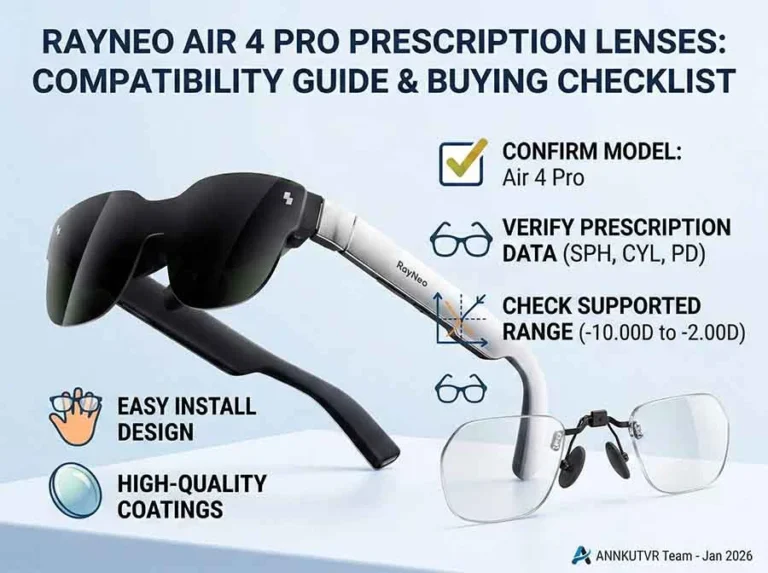
If you wear glasses for distance vision, you will likely need custom prescription lens inserts to get the sharpest experience from RayNeo Air 4 Pro. That is because the optical system presents a large virtual image that appears far away, not a tiny screen you read up close. RayNeo describes Air 4 Pro as a 201-inch virtual display at 6 meters, and the official product page highlights features such as dual 0.6-inch SeeYa Micro-OLED displays, HDR10 support, 1200 nits peak brightness, 200,000:1 contrast, and audio by Bang & Olufsen.
Not sure which RayNeo model or lens insert applies to you? You can also review our RayNeo prescription lenses guide to compare supported RayNeo models before deciding whether you need inserts.
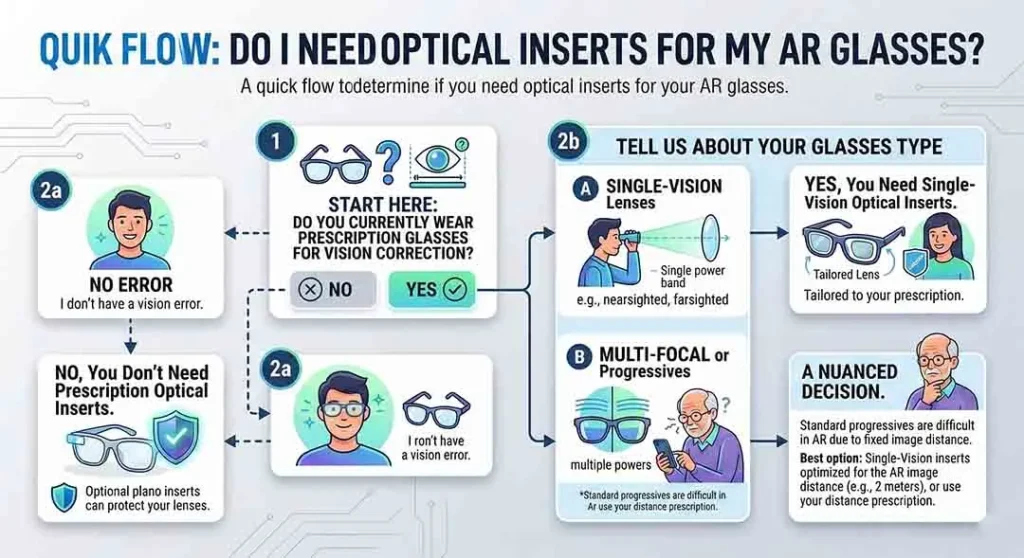
Table of Contents
The 3-Step Quick Check: Do You Need Lens Inserts?
Use this quick check before you order anything.
Step 1 — Distance Clarity
Do you see clearly when looking at a TV across the room, road signs, or a presentation screen without glasses or contacts? If not, you will likely benefit from prescription inserts, because AR display glasses are designed around distance-style viewing rather than close reading. RayNeo’s own prescription guidance says AR inserts are generally best as single vision distance lenses, since the virtual screen is usually projected at a fixed focal distance of about 4 meters / 13 feet.
Step 2 — Current Eyewear
Do you normally wear glasses or contacts for driving, cinema, meetings, or watching TV? If yes, you will likely need inserts for Air 4 Pro as well. A blurry distance prescription in daily life usually means a blurry virtual screen in AR.
Step 3 — Astigmatism or Complex Vision
Does your prescription include CYL and AXIS values? If yes, custom inserts are especially important for sharp text and clean edges. If you have prism, unusually strong prescription values, or a prescription that is incomplete or outdated, do not rely on guesswork. Contact support or confirm your prescription with a licensed optometrist first. AAO explains that CYL is used to correct astigmatism and AXIS identifies the direction of that correction.
Find Your Vision Profile
Start with the profile that best matches how you normally see the world.
Profile A — Perfect Distance Vision
If you do not need glasses or contacts for distance vision, you likely do not need prescription inserts. RayNeo Air 4 Pro is prescription-ready, but not every user needs an insert. Users with normal distance vision can usually enjoy the glasses as-is.
Profile B — Nearsighted (Myopia Only)
If you wear glasses to see a TV, road signs, or a laptop screen across the room, you will likely want prescription inserts. RayNeo’s official prescription purchase support indicates support for myopia up to -10.00D through the standard ordering path. Many first-time users assume that because the displays sit close to the eyes, they can simply remove their everyday glasses and still see clearly. That is the wrong mental model. The virtual image behaves like a distant screen, so distance correction is usually what matters.
Profile C — Nearsighted with Astigmatism
If your prescription includes astigmatism, do not order based on SPH alone. You typically need SPH + CYL + AXIS + PD for a proper result. AAO and other optical prescription guides explain that CYL is the amount of astigmatism correction and AXIS is the direction of that correction. Without those values, text and high-contrast edges may not look crisp. RayNeo’s standard supported range includes astigmatism up to -2.00D in the regular online flow.
Profile D — Reading Glasses or Presbyopia (ADD)
If you only use reading glasses and your distance vision is otherwise clear, you may not need inserts at all. This is one of the most common points of confusion for AR buyers. Reading glasses are made for near tasks such as books, labels, and phone screens. RayNeo’s own 2026 prescription guidance says AR inserts are generally best as single vision distance because the virtual screen is projected at a fixed focal distance, usually around 4 meters. That means ADD is usually not the number you build an AR insert around. AAO also defines ADD as the extra power used in multifocal lenses for near work.
Profile E — High Prescription, Prism, or Complex Vision Needs
If your prescription is unusually strong, includes prism, or you have double vision, binocular vision issues, or other complex needs, do not self-order based on a standard template. RayNeo’s standard support materials focus on supported ranges for common prescriptions, while prism and other complex cases are better handled through manual review.
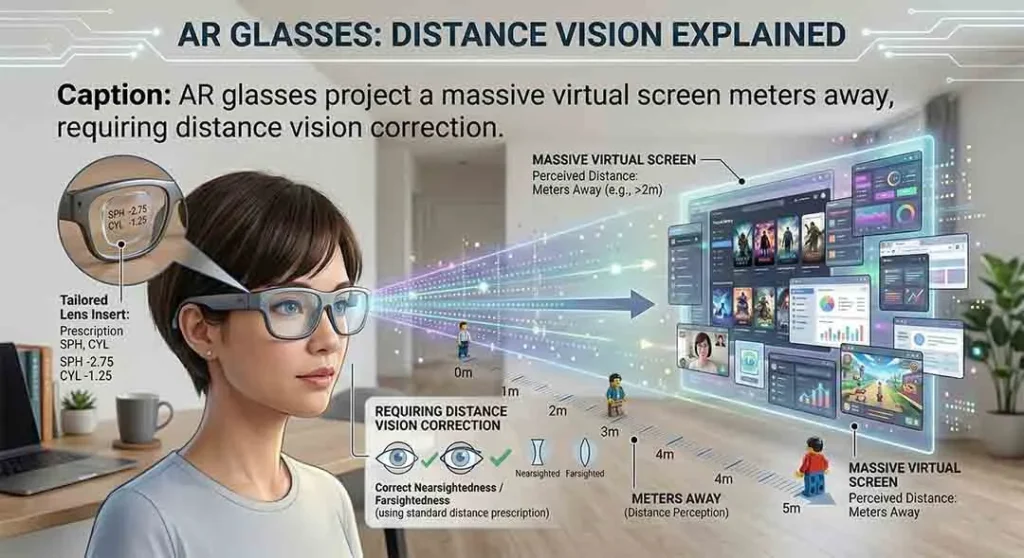
Why AR Glasses Use Distance Vision, Not Reading Glasses
This is the key idea behind the whole page. RayNeo Air 4 Pro may sit close to your face, but your eyes are not focusing on a phone-like screen at reading distance. Instead, the optical system creates a virtual image that appears much farther away. RayNeo markets Air 4 Pro as a 201-inch virtual screen at 6 meters, and RayNeo’s own prescription FAQ says that AR glasses generally work with a fixed focal distance of about 4 meters / 13 feet. That is why the company recommends single vision distance lenses instead of progressive lenses for most AR insert use cases.
In simple terms: your eyes are being asked to look far, not read near.
For most users, that means:
distance correction matters most,
reading ADD usually does not,
and progressive designs are often unnecessary for a dedicated AR insert.
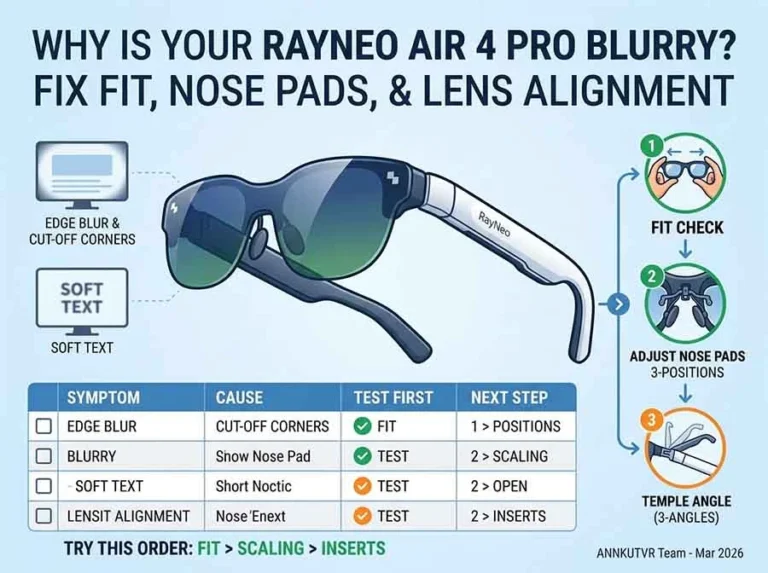
RayNeo’s own smart-glasses prescription guidance explains that wearing AR glasses over regular glasses can push the device farther away from your eyes and shrink the effective viewing area. That can make corners harder to see clearly and reduce overall comfort. RayNeo positions prescription-ready products as a better fit for users who need full correction inside the device.
In real-world use, regular glasses underneath can also change the viewing angle and make the fit less stable. If your goal is the best image quality and most consistent comfort, custom inserts are usually the cleaner solution. A recent user discussion in the RayNeo subreddit also describes both stacked glasses and contacts as uncomfortable compromises for some wearers.
Supported Prescription Ranges: Can You Order Directly?
RayNeo’s official materials and prescription guidance give a clear baseline for common prescriptions. The practical takeaway is that standard online ordering works best for simple cases inside the supported range.
| Condition | Standard Range | Online Order? | What You Need |
|---|---|---|---|
| Myopia (SPH) | 0.00 to -10.00D | Yes | SPH + PD |
| Hyperopia (SPH) | up to +8.00D | Yes | SPH + PD |
| Astigmatism (CYL) | 0.00 to -2.00D | Yes | SPH + CYL + AXIS + PD |
| Prism / High CYL | Manual review | Contact Support | Recent prescription + review |
If your prescription is inside range, you can usually move forward with confidence. If it is outside range, incomplete, or unusually complex, use the support path instead of self-checkout.
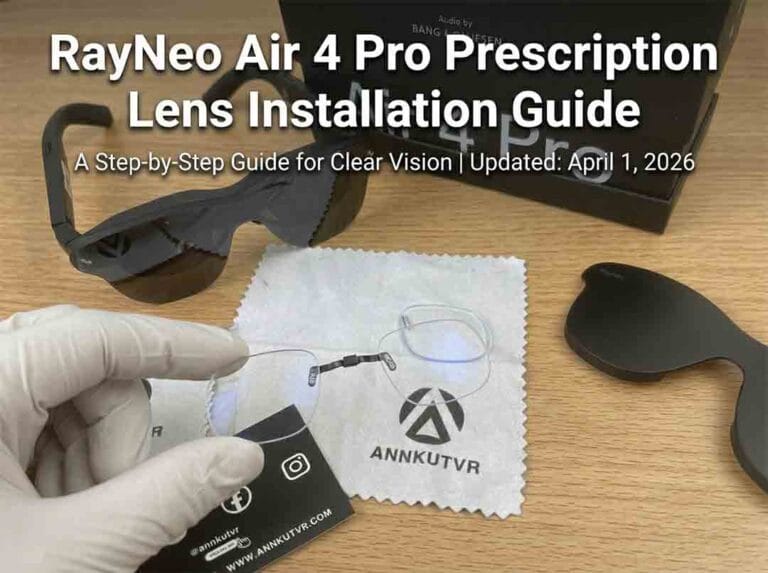
If you decide to order inserts, use the RayNeo Air 4 Pro prescription lens installation guide to seat them correctly and check fit before long sessions.
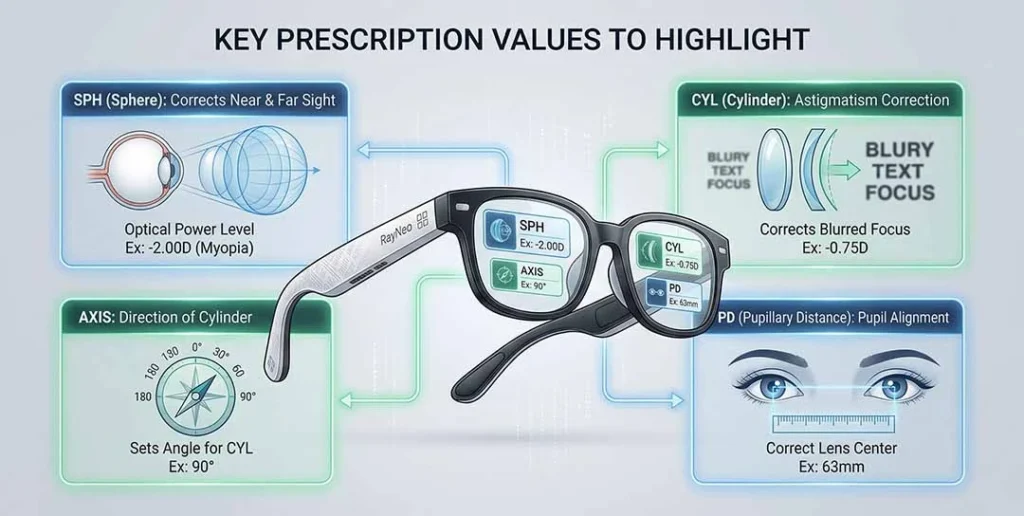
How to Read Your Prescription Slip for AR Inserts
OD / OS
These mean right eye and left eye. They are standard abbreviations in eyeglass prescriptions.
SPH (Sphere)
This is your base distance correction. A minus (-) number usually means nearsightedness. A plus (+) number usually means farsightedness. AAO identifies SPH as the lens power needed to correct vision.
CYL (Cylinder)
This is the amount of astigmatism correction. If you have astigmatism, this value matters.
AXIS
This is the direction of the astigmatism correction. If CYL is present, AXIS is usually needed too.
PD (Pupillary Distance)
This is the distance between your pupils. PD helps align the optical center of the inserts with your eyes. If it is wrong, clarity and comfort may suffer.
ADD
This is the extra power used in multifocal lenses for near work. For RayNeo Air 4 Pro inserts, this is usually not the number you build the insert around, because the virtual image is typically meant to be viewed at distance.
Prescription Readiness Check: Can You Order Yet?
Use this checklist before you place an order:
Only SPH, no astigmatism history: usually okay to proceed.
CYL listed, but no AXIS: stop and get AXIS first.
No PD on file: get it measured before ordering.
Prism on the prescription: contact support.
Prescription is old or you are unsure it still reflects your vision: update it first.
Only a contact lens prescription: do not assume it is identical to a glasses prescription. A recent, accurate prescription usually gives the best chance of getting both comfort and clarity right on the first try.
Using Contact Lenses with RayNeo Air 4 Pro
If you already wear contact lenses, you can usually use RayNeo Air 4 Pro without inserts while your contacts are in. But if you want dedicated inserts for long viewing sessions at home, do not assume your contact lens prescription is always the same as your glasses prescription. Contact lenses sit directly on the eye, while glasses and inserts sit farther away, and that distance difference can matter more as prescriptions get stronger.
In practice, many users prefer dedicated inserts for longer sessions so they can avoid the discomfort that can come with extended contact lens wear. If you are unsure, use a recent glasses prescription or ask a licensed optometrist to confirm the correct spectacle values before ordering. A recent community post also notes that contact lenses can be a workable option, but not always the most comfortable one over time.
Frequently Asked Questions Before Buying
Do I need reading glasses or a distance prescription for AR glasses?
In most cases, AR insert prescriptions are based on distance vision, not reading ADD, because the virtual screen is presented at a fixed focal distance rather than a near reading distance.
Can I just provide SPH if I have astigmatism?
No. If you have astigmatism, you usually need CYL and AXIS as well, and in practice you will also want SPH and PD included for a complete order.
Can I use my contact lens prescription to order inserts?
Not always. Contact lens prescriptions and glasses prescriptions are not always interchangeable because of vertex distance and fitting differences. For stronger prescriptions, use a recent glasses prescription or confirm with an eye-care professional.
Do I need PD to order AR inserts?
Yes, PD is important because the optical center of the insert should line up with your pupils as closely as possible. Incorrect PD may reduce comfort or clarity.
What if my prescription is over the supported range?
If your prescription is outside the standard supported range, use the support path instead of guessing. Complex cases are better handled through manual review.
Can I order if my prescription is expired?
It is better to use a valid, recent prescription. If your prescription is old or you are unsure whether it still reflects your vision, update it before ordering.
Are RayNeo Air 3S inserts compatible with Air 4 Pro?
Some older insert frames may appear similar, but for the best fit and optical alignment it is safer to use inserts that are specified for RayNeo Air 4 Pro or confirmed by a verified partner. RayNeo Air 4 Pro uses updated HueView 2.0 optics, so best results depend on the right insert geometry.
Can I wear regular glasses under the Air 4 Pro instead?
You might be able to, but it is usually not the best setup for comfort, fit, or viewing quality. Stacking regular glasses can push the AR optics farther away and reduce the usable viewing area.
Will the inserts scratch the AR display?
Official or verified inserts are designed to sit with clearance from the optical system rather than pressing directly against the display surfaces. Use the correct insert model and follow the installation instructions carefully.
Medical Disclaimer
The information on this page is provided for general educational purposes about AR hardware compatibility and prescription lens planning. It does not replace a professional eye exam, diagnosis, or prescription advice. Always use a valid, recent prescription from a licensed optometrist or ophthalmologist. If you have prism, double vision, unusual binocular vision symptoms, or a prescription near or beyond the supported range, seek professional advice before ordering. AAO’s prescription guidance also makes clear that correct prescription values matter for safe and comfortable viewing.
RayNeo Air 4 Pro itself is positioned as an eye-comfort-focused display product, with official marketing highlighting features such as TÜV SÜD low blue light certification. That does not replace the need for the right prescription data. It simply means the hardware is designed for more comfortable long-form viewing when used correctly.
Ready to Experience HDR10 AR Clearly?
RayNeo Air 4 Pro combines a large virtual display, HDR10 support, high brightness, and a prescription-ready design. If your distance vision needs correction, the right inserts can make the difference between “good enough” and truly sharp.