Enjoy 5% OFF + FREE shipping on orders $49+! Use Code: 202512AK5

RayNeo GT vs GT Max: IPD, FOV, Fit and Prescription Lens Differences
RayNeo GT and GT Max are built around the same basic idea: full-color AR display glasses for movies, gaming, handheld consoles, laptops, and large virtual screens.
The buying decision comes down to a few differences that actually matter.
RayNeo GT uses a 46° field of view, 49 PPD, weighs 68g, and has a fixed 64mm IPD.
RayNeo GT Max expands the field of view to 59°, uses 38 PPD, weighs about 78g, and comes in three IPD-specific versions: S, M, and L.
For prescription wearers, that IPD difference matters just as much as the larger GT Max display.
A prescription insert corrects your eyesight. It does not change where your pupils sit relative to the AR optics.
RayNeo GT vs GT Max Specifications
| Feature | RayNeo GT | RayNeo GT Max |
|---|---|---|
| Field of view | 46° | 59° |
| Resolution | 1920 × 1080 | 1920 × 1080 |
| Pixel density | 49 PPD | 38 PPD |
| Default virtual display | 201″ | 267″ |
| IPD | Fixed 64mm | S <64mm / M 64–67mm / L >67mm |
| Weight | 68g | Approx. 78g |
| 2D refresh rate | Up to 120Hz | Up to 120Hz |
| Prescription support | Prescription insert | Prescription insert |
RayNeo’s current GT documentation confirms the same basic split: GT uses the lighter 68g frame, 46° FOV, 49 PPD, and fixed 64mm IPD, while GT Max moves to a 59° FOV and S/M/L IPD-specific hardware.
For the official sizing and fit guidance, see RayNeo GT Series Support.
The Main Display Trade-Off: 46° vs 59° FOV
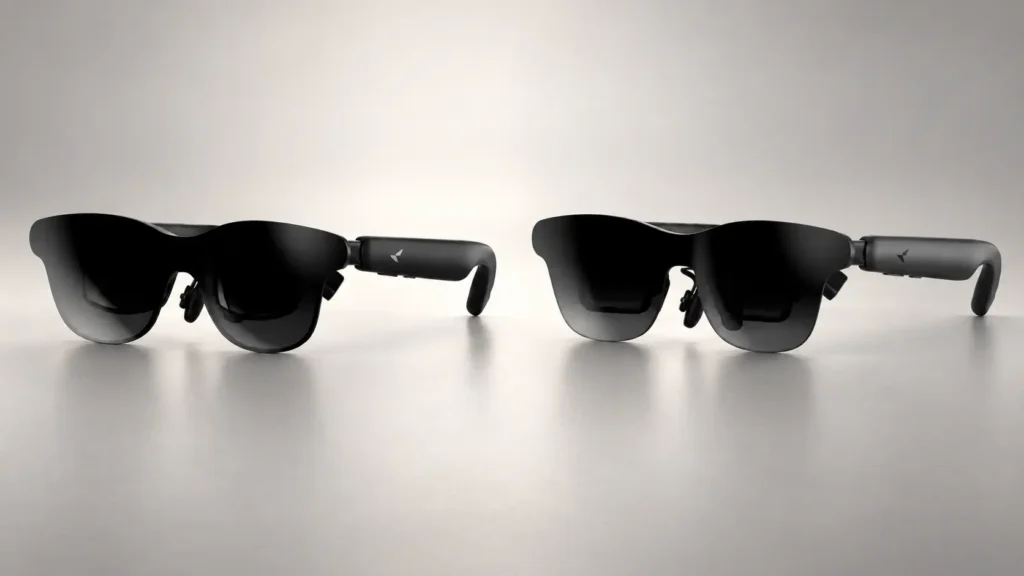
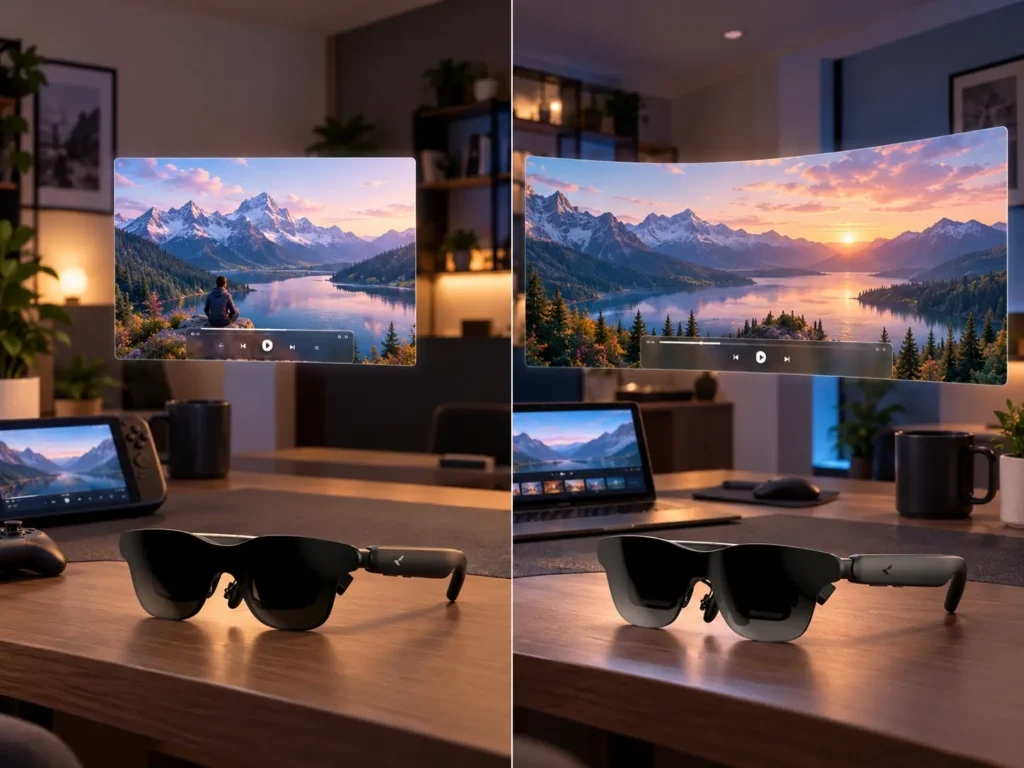
The most obvious difference is how much of your view the virtual display occupies.
GT uses a 46° field of view.
GT Max increases that to 59°.
The default virtual display also grows from approximately 201 inches on GT to 267 inches on GT Max.
For gaming and movies, that wider GT Max image can feel more cinema-like.
But the larger FOV comes with an important trade-off.
Both models use the same 1920 × 1080 display resolution.
GT concentrates those pixels into a narrower viewing area and reaches 49 PPD.
GT Max spreads the same resolution across a wider view and drops to 38 PPD.
So the difference is better described as:
GT: narrower image, higher pixel density.
GT Max: wider image, lower pixel density.
If movies and games are your priority, the extra width may matter more.
If you expect to read smaller interface elements or use the glasses as a virtual monitor, GT’s higher PPD is worth considering rather than choosing based on FOV alone.
IPD Is the Bigger Fit Difference
For some buyers, GT Max’s biggest advantage is not the 59° FOV.
It is the IPD system.
RayNeo GT uses a fixed 64mm IPD.
GT Max is sold in three optical configurations:
S: below 64mm
M: 64–67mm
L: above 67mm
These are separate hardware versions, not a mechanical slider that you adjust after purchase.
That makes measuring your IPD before ordering particularly important.
If your own IPD sits close to GT’s fixed 64mm geometry, the standard GT may work without creating an additional sizing decision.
If your IPD sits farther away from 64mm, GT Max gives you more flexibility because you can select an optical configuration closer to your eye spacing.
One measurement is already creating a lot of buyer questions:
64mm.
RayNeo’s published ranges place 64mm inside the M range, while S is for measurements below 64mm. Real GT Max buyers have also been asking specifically about the S-versus-M choice at exactly 64mm.
That boundary deserves its own guide rather than turning this comparison into a full IPD sizing article.
IPD and Physical Fit Are Different Problems
IPD describes the horizontal relationship between your pupils and the optical system.
It does not tell you exactly how high or low the glasses will sit on your face.
GT and GT Max also use nose-pad adjustments to change vertical eye alignment.
RayNeo’s support guidance specifically recommends trying different nose-pad heights and slightly changing frame position when the image is not centered or when the edges remain blurry.
That means there are two different questions:
Does the optical IPD match my eyes?
Does the frame sit at the correct height in front of my eyes?
Changing nose-pad height can improve vertical alignment.
It does not change the underlying IPD of the device.
Prescription Lenses Do Not Change the IPD
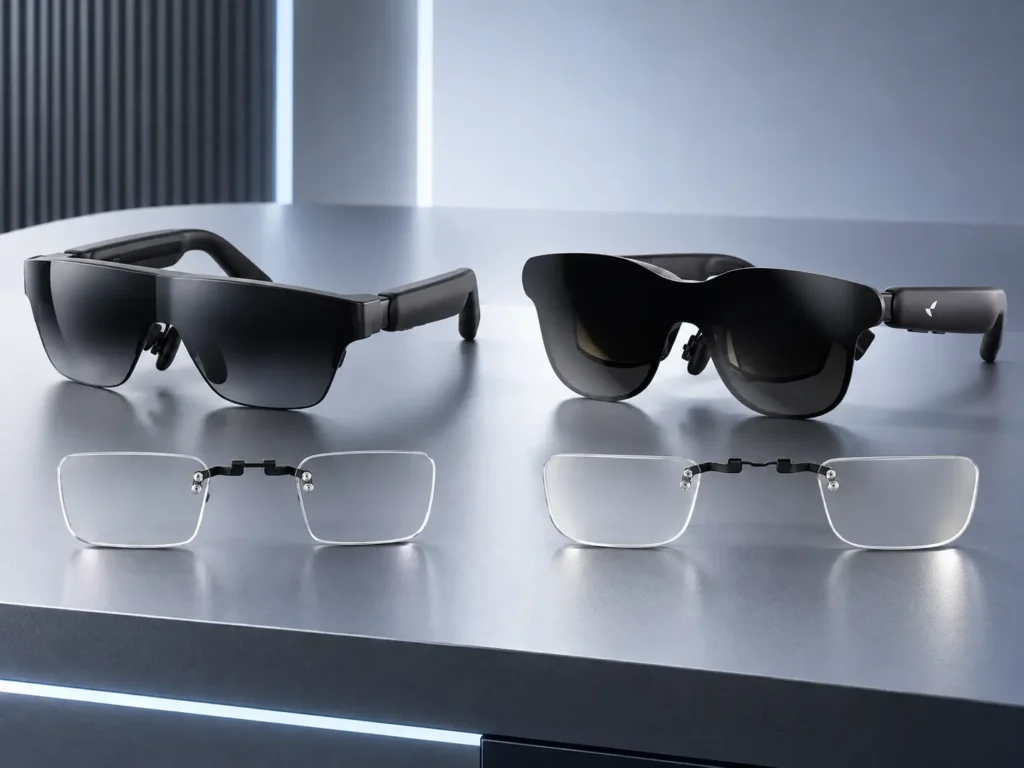
Both GT and GT Max support prescription inserts.
For anyone who normally relies on glasses for clear distance vision, that removes the need to stack regular eyeglasses underneath the AR frame.
But prescription correction and optical fit still solve different problems.
A prescription insert can correct refractive errors such as myopia and astigmatism.
It does not change:
GT’s fixed 64mm IPD
or
GT Max’s S/M/L optical configuration.
So the correct order is not:
Buy prescription lenses first and hope the fit works.
It is:
Choose the device → confirm IPD → confirm physical fit → add prescription correction.
ANNKUTVR provides separate lens solutions for each model:
RayNeo GT Max Prescription Lenses
RayNeo also treats prescription inserts as model-specific rather than universal across different frames.
Which One Makes More Sense for You?
GT Max should not automatically be treated as the better model simply because it has the larger display.
RayNeo GT makes more sense if:
You prefer the lighter 68g frame.
You value the higher 49 PPD.
A 46° FOV is already large enough for your use.
Your IPD works well with the fixed 64mm optical configuration.
RayNeo GT Max makes more sense if:
You want the wider 59° FOV.
A larger cinema-style virtual image matters more than maximum pixel density.
Your IPD benefits from choosing S, M, or L rather than using a fixed 64mm layout.
You are comfortable accepting the additional weight for the wider display.
For prescription wearers, neither decision starts with the lens prescription itself.
The more useful sequence is:
Display preference → IPD → physical fit → prescription correction.
If you are still comparing the wider RayNeo lineup, the RayNeo Prescription Lenses Hub includes the current ANNKUTVR options for GT, GT Max, iO, and other RayNeo models.
Frequently Asked Questions
Can RayNeo GT and GT Max use the same prescription lenses?
No. RayNeo GT and GT Max should be treated as separate prescription-lens systems. Prescription inserts are designed around the frame, bridge, attachment points, and optical layout of a specific model, so use the insert made for the exact device you own.
Is RayNeo GT Max S, M, or L based on IPD or face size?
The S, M, and L versions are primarily based on IPD. RayNeo currently lists S for IPDs below 64mm, M for 64–67mm, and L for measurements above 67mm. Face shape and nose fit can still affect comfort and vertical positioning, but they do not replace the IPD sizing decision.
I have a 64mm IPD. Should I choose RayNeo GT Max S or M?
According to RayNeo’s published sizing ranges, 64mm falls into the M range, while S is listed for measurements below 64mm. Because 64mm sits directly on the sizing boundary, measure your IPD carefully before ordering rather than assuming either size will fit the same way.
Why can the center look clear while the edges look blurry on RayNeo GT Max?
Edge blur can involve several different factors, including IPD alignment, nose-pad height, frame position, virtual screen size, and prescription correction. It should not automatically be treated as evidence that the prescription lenses are wrong.
Can I reuse prescription lenses from an older RayNeo model on GT or GT Max?
Do not assume an insert from an older RayNeo model will fit GT or GT Max. Prescription inserts depend on the physical frame, bridge, attachment structure, and available optical space of the specific device. Use an insert designed for the exact RayNeo model.