Enjoy 5% OFF + FREE shipping on orders $49+! Use Code: 202512AK5

RayNeo GT Max IPD Size Guide: Should You Choose S, M or L?
If you already know you want the RayNeo GT Max, there is one choice you should settle before ordering: S, M or L.
RayNeo currently defines the three GT Max IPD sizes as:
- S: IPD below 64mm
- M: IPD from 64mm through 67mm
- L: IPD above 67mm
That means the two boundary cases are less ambiguous than they may first appear:
64mm = M
67mm = M
RayNeo’s current GT Series support page explicitly lists Medium as 64 ≤ IPD ≤ 67mm, rather than treating 64mm or 67mm as overlapping sizes. RayNeo also recommends measuring your IPD before ordering because GT Max is sold in separate IPD-specific sizes.
The more difficult question is what to do when your measurements keep moving around one of those boundaries. That is where measuring carefully matters more than trying to invent a “size up” or “size down” rule.
RayNeo GT Max S, M and L IPD Sizes Explained
GT Max does not use one frame with a continuously adjustable IPD control. You choose an IPD-specific S, M or L version when ordering. RayNeo’s own product and support pages describe these as three separate GT Max size options.
| GT Max Size | Official IPD Range | Example | What It Means |
|---|---|---|---|
| S | Below 64mm | 60mm, 62mm, 63.5mm | Choose S when your confirmed IPD remains below 64mm. |
| M | 64–67mm, inclusive | 64mm, 65mm, 66mm, 67mm | Both official boundary values, 64mm and 67mm, fall within M. |
| L | Above 67mm | 67.5mm, 68mm, 70mm | Choose L once your confirmed IPD is above 67mm. |
If you are still deciding between the standard GT and GT Max rather than choosing a GT Max size, see the RayNeo GT vs GT Max comparison first. That comparison covers the broader model differences; this guide assumes you have already decided on GT Max.

Measure Your IPD Before Choosing a GT Max Size
IPD, or interpupillary distance, is the distance between the centers of your pupils.
For ordinary eyewear it is already an important optical measurement. With display glasses, it also matters because your eyes need to sit in the intended viewing position relative to the display optics.
RayNeo provides its own mobile IPD measurement tool and currently notes that the tool should be opened in a smartphone browser. Its GT Series support documentation specifically recommends measuring before placing a GT Max order.
The important part is not to turn one measurement into false precision.
If you repeatedly measure around 65mm, for example, you are comfortably inside the Medium range.
If you get:
- 66.0mm
- 66.2mm
- 66.1mm
there is little reason to manufacture a sizing dilemma that is not there.
But if you get:
- 63.8mm
- 64.2mm
- 64.0mm
or:
- 66.8mm
- 67.2mm
- 67.0mm
then the result sits directly around a size boundary. Repeating the measurement under consistent conditions makes more sense than blindly following whichever number appeared first.
Recent GT Max owner discussions show why this matters. One user reported an initial phone measurement of 64.7mm, then obtained measurements closer to 58mm when repeating the process under different conditions. That is an individual report rather than evidence that every phone measurement will vary, but it illustrates why a borderline reading deserves a second check.
If your own measurements remain inconsistent enough to cross an S/M or M/L boundary, confirming your PD/IPD through an eye-care professional is the cleaner solution.
If Your IPD Is Exactly 64mm, Choose M Under RayNeo’s Current Sizing
This is one of the most common points of confusion around GT Max sizing.
A real GT Max buyer recently asked whether an exact 64mm IPD should mean S or M after seeing sizing language that made the boundary appear ambiguous.
RayNeo’s current support documentation resolves that directly:
S = below 64mm
M = 64mm through 67mm
So if your confirmed IPD is exactly 64mm, the official size is M.
There is no need to create an unofficial rule saying that every 64mm user should size down to S or size up for additional room.
The more useful question is whether your 64mm measurement is stable.
If one measurement says 64.0mm while several others put you below 64mm, verify the measurement before ordering. The issue is then measurement consistency, not a hidden overlap in RayNeo’s current sizing table.
If Your IPD Is Exactly 67mm, M Still Applies
The other boundary is 67mm.
RayNeo defines Medium as:
64 ≤ IPD ≤ 67mm
and Large as:
IPD > 67mm.
So:
67.0mm = M
while a confirmed measurement above 67mm moves into L.
This boundary is also appearing in current GT Max discussions. Users around 66–68mm have been asking whether they should choose Medium or Large, which is exactly why the distinction between a stable measurement and a fluctuating measurement matters.
If your repeated measurements consistently land at 66.5–67.0mm, that still sits inside RayNeo’s stated Medium range.
If you repeatedly move between something like 66.8mm and 67.4mm, do not solve the problem by guessing which direction feels safer. Verify the measurement first.
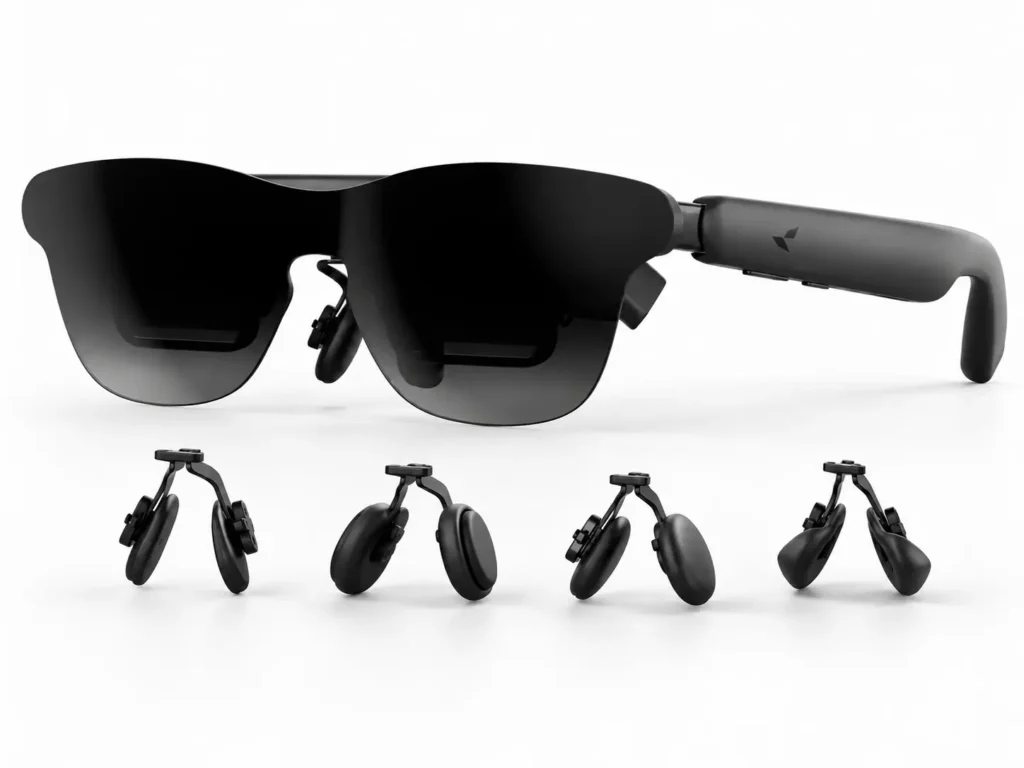
Don’t Confuse GT Max IPD Size With Nose-Pad Fit
GT Max sizing and nose-pad adjustment affect different parts of the fit.
The S/M/L choice is the GT Max IPD size you select when purchasing the glasses.
The nose pads affect how the glasses sit on your face: their position, distance and vertical alignment relative to your eyes.
Those two variables can interact with what you see, but they are not interchangeable.
This distinction has already become a real troubleshooting question among GT Max owners. Some users report that changing nose-pad position changes how much of the display they can see, while others discover that their original IPD measurement or GT Max size was wrong.
So changing nose pads should not be described as converting an S optical size into an M, or an M into an L.
At the same time, seeing a soft corner does not automatically prove that you ordered the wrong IPD size. Wearing position can also change the view.
That distinction deserves its own troubleshooting process, which is why edge blur, nose-pad alignment and prescription blur should be diagnosed separately rather than treating every blurry edge as an IPD problem.
How to Tell When You Should Recheck Your IPD
You do not need to keep measuring indefinitely when the result is stable.
Rechecking becomes more useful when:
- repeated measurements fall on opposite sides of 64mm or 67mm;
- your first measurement was taken quickly under poor conditions;
- the GT Max size you received seems inconsistent with the IPD you expected;
- your measured IPD differs substantially from a recent professional PD/IPD measurement.
Do not use visual symptoms alone as a substitute for measurement.
Blur, an incomplete view of an edge or a display that looks better after repositioning the glasses can involve more than one fit variable. Current user reports show combinations of IPD concerns and nose-pad positioning, so there is no reliable rule that every corner problem means “wrong size.”
That troubleshooting belongs after you first establish the basic fact: does your actual IPD fall into S, M or L?
Prescription Lenses Do Not Change Your GT Max IPD Size
This is another distinction worth settling before ordering accessories.
A prescription lens corrects refractive errors such as myopia or astigmatism according to the prescription values used to make the lens.
It does not change which GT Max IPD size your eyes match.
ANNKUTVR therefore treats these as two separate checks:
- choose the appropriate GT Max S, M or L device size from your IPD;
- provide the correct prescription information for your prescription insert.
The RayNeo Prescription Lens Hub follows the same separation, and the RayNeo GT Max Prescription Lenses page is specifically for GT Max rather than the standard GT.
Correct prescription lenses can address your eyesight inside the viewing setup. They cannot compensate for choosing a GT Max hardware size that does not match your IPD.
GT Max Size Checklist Before You Order
Before choosing S, M or L:
- Measure your IPD instead of estimating it from face or eyeglass-frame width.
- Repeat the measurement if you are close to 64mm or 67mm.
- Use RayNeo’s current official ranges: S below 64mm, M from 64–67mm inclusive, L above 67mm.
- Treat exactly 64mm as M.
- Treat exactly 67mm as M.
- Do not treat nose-pad adjustment as a replacement for choosing the correct IPD size.
- Handle prescription correction separately from GT Max device sizing.
RayNeo’s current GT Series Support documentation is the primary reference for the size boundaries and measurement guidance. RayNeo GT Series Support
FAQ
What RayNeo GT Max size should I choose if my IPD is exactly 64mm?
Choose M according to RayNeo’s current official sizing. RayNeo lists S for IPD below 64mm and M for 64mm through 67mm, inclusive. If your measurements repeatedly move above and below 64mm, verify your IPD again before ordering rather than choosing a size from one borderline reading.
What RayNeo GT Max size should I choose if my IPD is exactly 67mm?
RayNeo currently places exactly 67mm in the M range. Medium covers 64mm through 67mm, while L is for IPD above 67mm. If your measurements fluctuate around the 67mm boundary, confirm your IPD before choosing between M and L.
Should I measure my IPD more than once before ordering RayNeo GT Max?
If your result is stable and clearly inside one size range, repeated testing is unlikely to change the decision. Measuring again is more useful when your result sits near 64mm or 67mm, especially if different attempts fall on opposite sides of a boundary.
Can the GT Max nose pads compensate for choosing the wrong IPD size?
No. Nose-pad adjustment changes how the glasses sit relative to your eyes and can affect viewing position, distance and vertical alignment, but it does not change the S, M or L IPD size of the GT Max itself. IPD sizing and nose-pad fit should be treated as separate variables.
Do prescription lenses change which RayNeo GT Max IPD size I need?
No. Prescription lenses provide vision correction based on your prescription, while GT Max S, M and L refer to the device’s IPD sizing. Choose the appropriate GT Max size from your IPD first, then handle your prescription lens requirements separately.