Enjoy 5% OFF + FREE shipping on orders $49+! Use Code: 202512AK5

VR Prescription Lens Guide: Should You Choose 1.56, 1.61, or 1.67 Index?
Table of Contents
Introduction
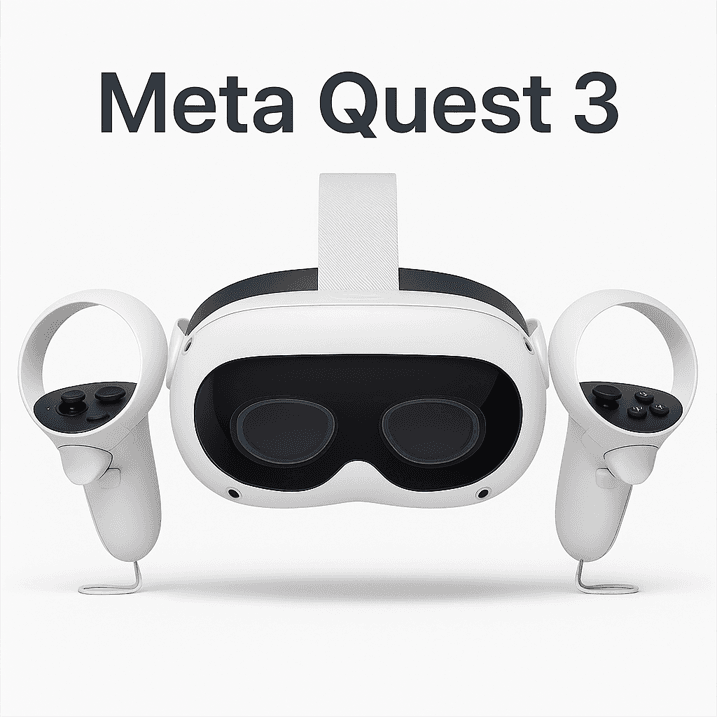
When buying prescription lens inserts for your Meta Quest 3 or Quest 2, you are often faced with a confusing choice: Refractive Index. You’ll see numbers like 1.56, 1.61, or 1.67.
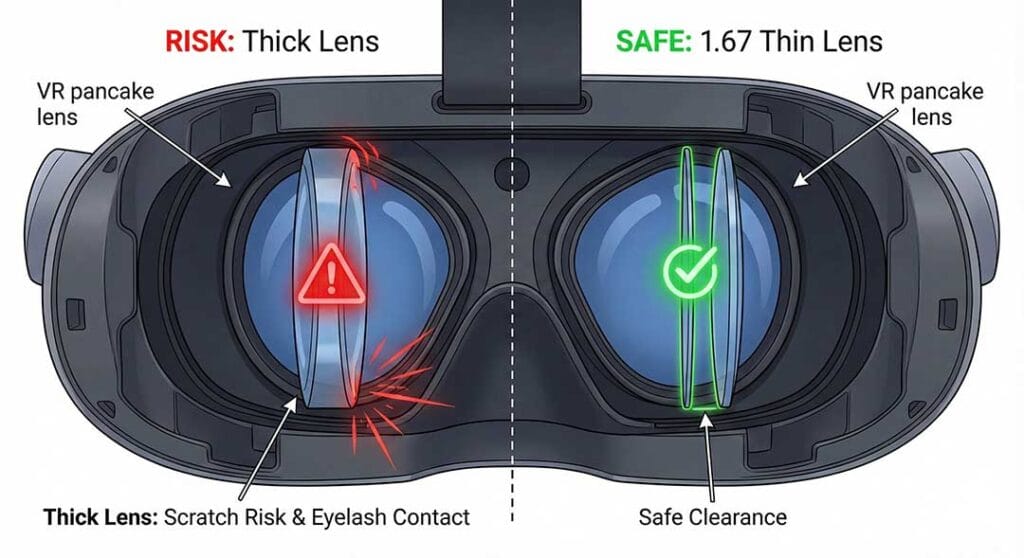
Many users ignore this and just pick the cheapest option, but in VR, thickness matters more than you think. A lens that is too thick can touch your eyelashes or, worse, scratch the VR headset’s own lenses.
This guide cuts through the technical jargon to tell you exactly which index fits your prescription.
What is Lens Index? (The Simple Version)
The “Index” number tells you how efficiently the lens material bends light.
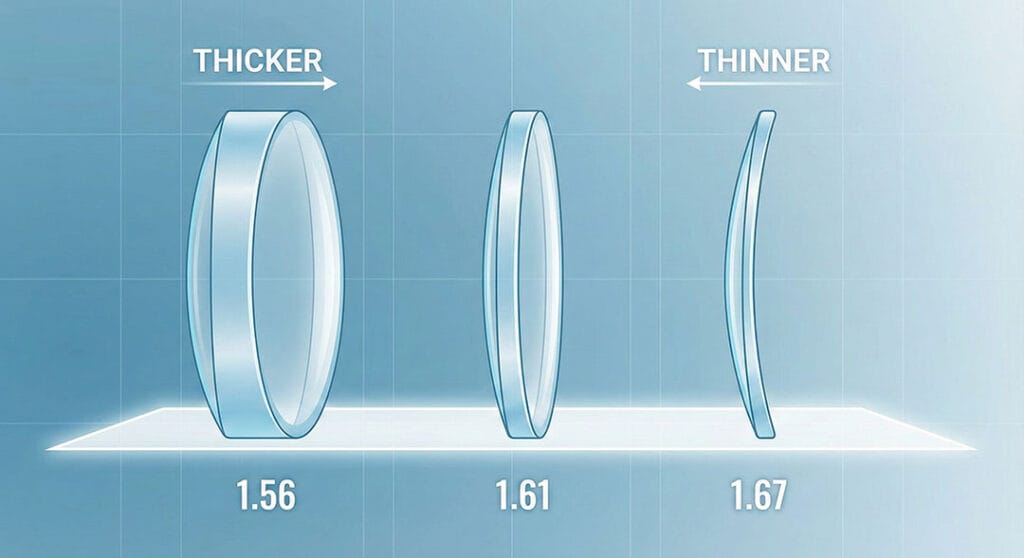
Higher Number (e.g., 1.67) = The lens bends light more efficiently, so it can be made thinner and lighter.
Lower Number (e.g., 1.56) = The lens needs more material to correct vision, resulting in a thicker and heavier lens.
The Breakdown: Which Index is Best for Your Prescription?
Here is the standard industry recommendation for VR inserts to ensure the best balance of safety, clarity, and price.
1.56 Index (Standard Index)
Best for: Low prescriptions (Spherical power: 0.00 to -2.00).
Pros: Most affordable.
Cons: Thickest material.
Verdict: If you have very mild myopia, this is fine. But for anything stronger, it might be too bulky for a VR headset.
1.61 Index (Mid-Index / "Thin")
Best for: Mild to Medium prescriptions (Spherical power: -2.00 to -4.00).
Pros: Roughly 20% thinner than standard lenses. More impact-resistant.
Verdict: This is the “sweet spot” for most players. It offers great value and is thin enough to safely sit inside the headset without touching your face.
1.67 Index (High-Index / "Super Thin")
Best for: Medium to Strong prescriptions (Spherical power: -4.00 to -8.00).
Pros: About 30% thinner than standard lenses.
Verdict: Highly Recommended for VR. In VR, every millimeter counts. If your prescription is over -4.00, a standard lens might stick out too much and scratch your Quest 3 lenses. A 1.67 lens keeps a low profile, protecting your expensive equipment.
1.74 Index (Ultra High-Index)
Best for: Very strong prescriptions (Spherical power: -8.00 and above).
Pros: The thinnest plastic lens available.
Verdict: Essential for strong prescriptions to keep the headset wearable.
Why Thickness Matters More in VR than in Real Life
When you wear regular glasses, if the lens is thick, it just looks a bit clunky. But inside a VR headset like the Quest 3:
Scratch Risk: A thick prescription lens sits dangerously close to the headset’s built-in pancake lenses. Friction can ruin your device.
Comfort: Thicker lenses add weight and can press against your brow bone or eyelashes, ruining immersion.
The ANNKUTVR Standard
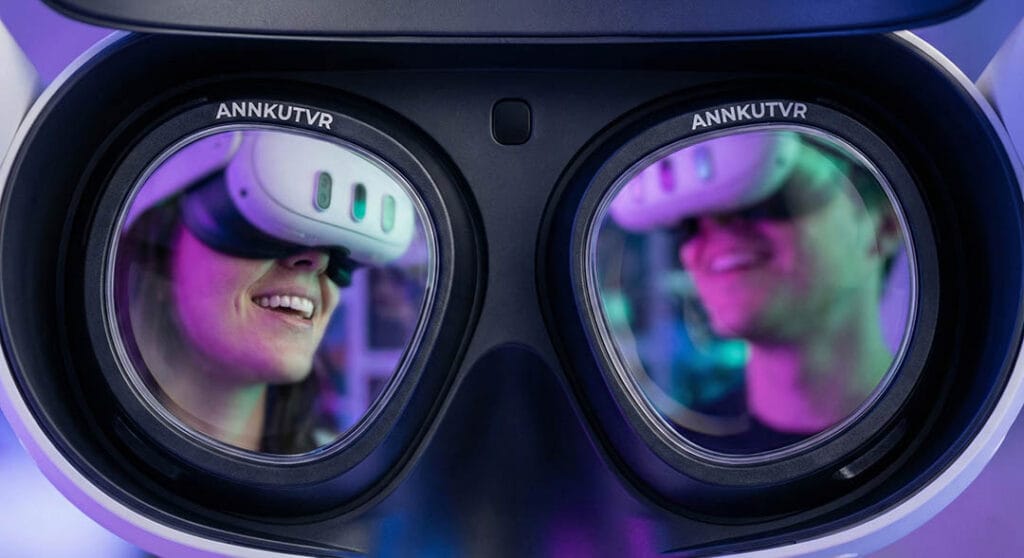
At ANNKUTVR, we understand that VR optics require precision. Unlike generic optical shops, we specialize in high-index materials optimized for VR clearance.
For most orders under -4.00, we recommend our 1.61 lenses for excellent clarity.
For stronger prescriptions, we provide 1.67 or 1.74 high-index options to ensure your lens inserts are sleek, safe, and invisible during gameplay.
Conclusion
Don’t guess with your vision.
Under -2.00? 1.56 is okay.
-2.00 to -4.00? Go for 1.61.
Over -4.00? Definitely invest in 1.67.
Choosing the right index protects your eyes and your headset. Check your prescription and select the perfect ANNKUTVR lenses for a crystal-clear virtual world.