Enjoy 5% OFF + FREE shipping on orders $49+! Use Code: 202512AK5

Why Do My Eyes Hurt in VR with Contacts? (And How to Fix It)
(Introduction) You put in a fresh pair of contact lenses, expecting full immersion in Horizon Call of the Mountain. The first 20 minutes are magical. But then, it starts. A gritty, sandy feeling in your eyes. Your vision gets slightly blurry, like you’re looking through a dirty window. You blink hard, trying to clear it, but it only stings more. By the time you take the headset off, your eyes are bloodshot and burning.
Sound familiar? You are not alone. While wearing contacts in VR seems like a good idea, for many gamers, it’s a recipe for disaster. This isn’t just “eye strain.” It’s a specific physiological reaction between your lenses and the VR environment. Here is exactly why it happens—and the only way to fix it permanently.
The Science: Why Contacts Dry Out Faster in VR
It’s not your imagination. Your contact lenses really are drying out faster in VR than in the real world. A groundbreaking 2025 study published in Optometry explains exactly why.
1. The 70% Drop in Blinking (The "Stare" Effect)
Contact lenses act like sponges; they rely on your tear film to stay soft and hydrated. Every time you blink, you “refuel” that moisture. However, the study found that while our normal blink rate is about 12.79 times per minute, it plummets to just 3.70 times per minute when playing intense action games.
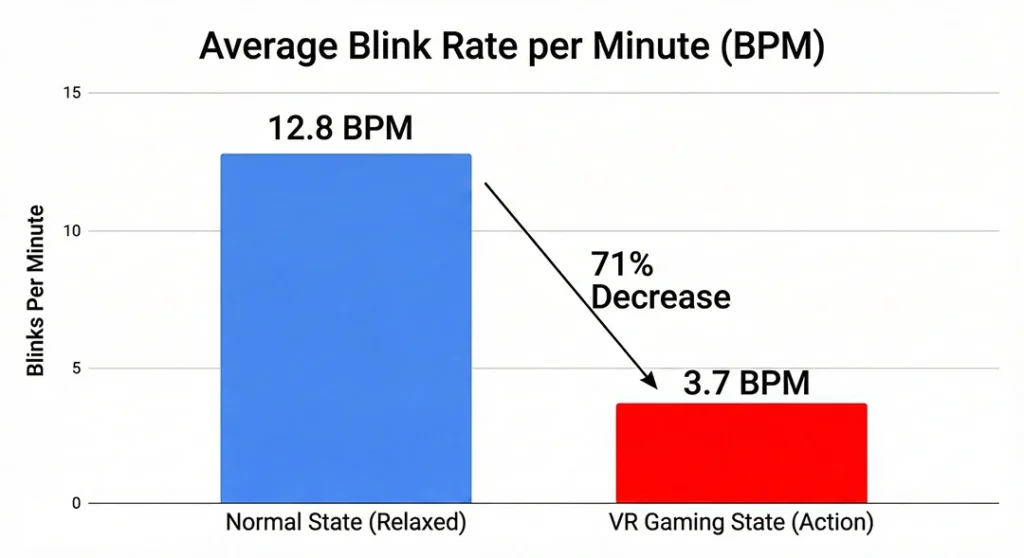
That is a 71% decrease. When you stop blinking, your contact lenses dehydrate. They tighten around your cornea, transforming from a soft lens into what feels like a dry piece of plastic.
2. You Only Blink When It's "Safe"
The same study revealed that gamers subconsciously suppress blinking during “high-dynamic scenes” (combat, climbing, racing). You only blink during “low-dynamic scenes” (loading screens or respawning). Since VR games are designed to be immersive non-stop action, your brain literally forbids you from blinking to avoid missing visual information. Your contacts never stand a chance.
3. The Heat & Fan Factor
Unlike a TV screen, a VR headset is a closed environment generating heat. The PSVR2 (and Quest 3) has an internal fan to prevent fogging. This fan creates a constant, subtle airflow across your eyes. Combine 70% less blinking with dry airflow, and you have the perfect recipe for rapid evaporation.
3 Signs Your Contacts Are Rejecting VR
How do you know if your pain is from contacts or just general fatigue? Watch for these three signs:
The “Post-Game Blur”: You take the headset off, but your real-world vision remains blurry for 5-10 minutes. This is caused by the dried-out lens warping slightly on your eye.
The “Sticky” Sensation: It feels like the lens is glued to your eyeball. Blinking feels rough, almost like sandpaper.
The “Foreign Body” Feeling: You suddenly feel the edges of your lens, something you usually don’t notice during the day.
Why Eye Drops Are Just a "Band-Aid"
When you search “VR dry eyes” on Reddit, most people suggest: “Just use rewetting drops!” or “Follow the 20-20-20 rule!” While these tips help, they are temporary maintenance, not a solution.
The Eye Drop Problem: To use drops, you have to pause the game, take off the headset (ruining immersion), find the bottle, apply drops, and put the headset back on. Repeat every 20 minutes. Is that really how you want to play?
The Infection Risk: Constantly touching your eyes and handling contacts mid-game with sweaty hands increases the risk of eye infections.
You don’t need a band-aid. You need a cure.
The Permanent Fix: Prescription Lens Inserts
If glasses are uncomfortable (and come with high risks of scratching your lenses), and contacts dry out, what is left?
These are custom-made lenses that snap directly onto the PSVR2’s optics. They sit in front of your eyes, not on them.
Why Inserts Win the Battle
| Feature | Contact Lenses ❌ | Glasses ❌ | ANNKUTVR Inserts ✅ |
|---|---|---|---|
| Moisture | Dries out rapidly | OK, but fogs up | Zero dryness (Natural) |
| Comfort | "Sandpaper" feeling | Pressure on temples | Invisible / Weightless |
| Safety | High infection risk | Risk of scratching lens | Protects headset lens |
| Convenience | Must wash hands/insert | Adjusting fit constantly | Pop on & Play |
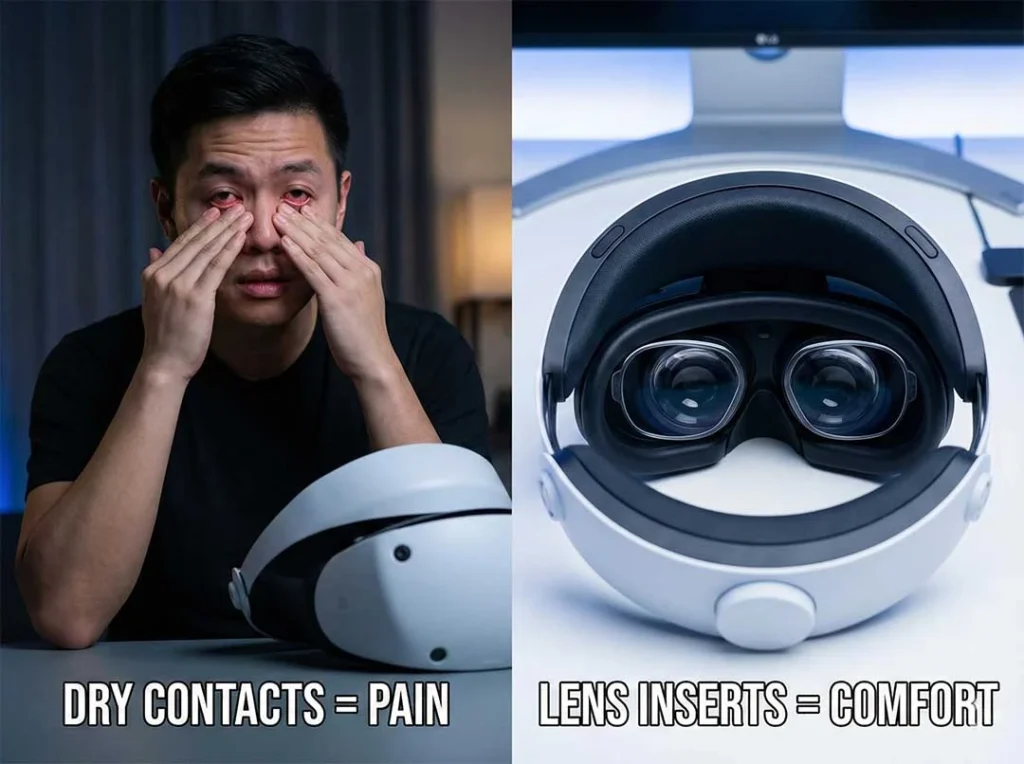
By switching to inserts, your eyes can function naturally. Even if your blink rate drops, your natural tear film is far more resilient than a plastic contact lens. You get 100% clarity with 0% dryness.
Want to know more about installation, cost, and sharing? Read our deep dive into all PSVR2 prescription lens benefits.
Recommendation: Check out ANNKUTVR Magnetic Prescription Lenses. They cost less than a 6-month supply of daily contacts and last for the lifetime of your headset.
What Gamers Are Saying (Real Reddit Stories)
“I thought I was just getting old. My eyes would burn after 30 mins of Gran Turismo. I switched from contacts to inserts, and now I can play for 3 hours straight with zero pain. It’s a game changer.” — u/VR_Racer_23
“Contacts in VR are a nightmare for me. They get so dry they pop out. Inserts are the best accessory I ever bought.” — u/TechDadVR
FAQ: VR & Eye Health
Can VR permanently damage my eyes?
No, there is no evidence of permanent damage. However, chronic dry eye from contact lens abuse can lead to corneal abrasions.
Is the PSVR2 fan making my eyes worse?
Yes. The airflow is necessary to stop the lenses from fogging, but it accelerates tear evaporation. Lens inserts act as a barrier, protecting your eyes from direct airflow.
I have astigmatism. Do inserts work for me?
Absolutely. ANNKUTVR lenses are custom-made to your exact prescription, including astigmatism (CYL and AXIS).
Conclusion
Don’t let dry, burning eyes ruin your immersion. You bought a PSVR2 to escape reality, not to be reminded of it by stinging contact lenses. The science is clear: Contacts and VR don’t mix. Ditch the drops, protect your eyes, and upgrade to the comfort of prescription lens inserts. Your eyes will thank you. Once you’ve fixed your vision, check out our list of other must-have PSVR2 accessories to complete your ultimate setup.
References
Marc Argilés et al., “Characterization of eye blink parameters during high and low-dynamic scenes in different video game genres,” Optometry – Journal of Optometry, 2025. Read Study.
American Academy of Ophthalmology, “Are Virtual Reality Headsets Safe for Eyes?” – Read Article.
About the Author
Written by the ANNKUTVR Team. We are VR optics experts dedicated to solving the unique visual challenges of virtual reality. With over 10 years of experience testing headsets from the Oculus Rift DK1 to the PSVR2, we help you see the metaverse clearly.